

THE FINE ART OF FLOW
Viscosity remains one of the most important and sophisticated decisions in modern vehicle lubrication
For experienced technicians, the numbers on an oil bottle or drum are familiar territory. But as vehicle technology evolves, viscosity has become about considerably more than choosing between a “thinner” or “thicker” oil.
Viscosity describes a lubricant’s resistance to flow. In a multigrade engine oil such as 0W-20 or 5W-40, the first number represents its low-temperature characteristics (the “W” denotes winter) while the second relates to viscosity at operating temperature.
The objective is balance: an oil that flows readily at start-up while maintaining the protective film required as temperatures and loads increase.
It is a balance Australian lubricant manufacturer Prolube Lubricants says it encounters across an increasingly diverse range of vehicle requirements.
Modern engines are being designed around more precisely specified lubricants, with lower-viscosity oils increasingly used to reduce internal friction and pumping losses. But lower isn’t automatically better. Viscosity, performance specification and engine design must work together.
Prolube says this is where full-synthetic formulations come into their own.
“Modern engines may be asking for lower-viscosity oils, but they certainly aren’t asking less of them,” Prolube Sales Manager, James Taliana said.
“The lubricant still needs to flow quickly from a cold start, withstand high operating temperatures and protect components under load.
“Synthetic base oils and advanced additive technology help achieve that balance, reducing friction and wear while supporting engine cleanliness and efficiency.
“Over the life of a vehicle, better protection also means less unnecessary wear and tear, helping components perform as intended, for longer.”
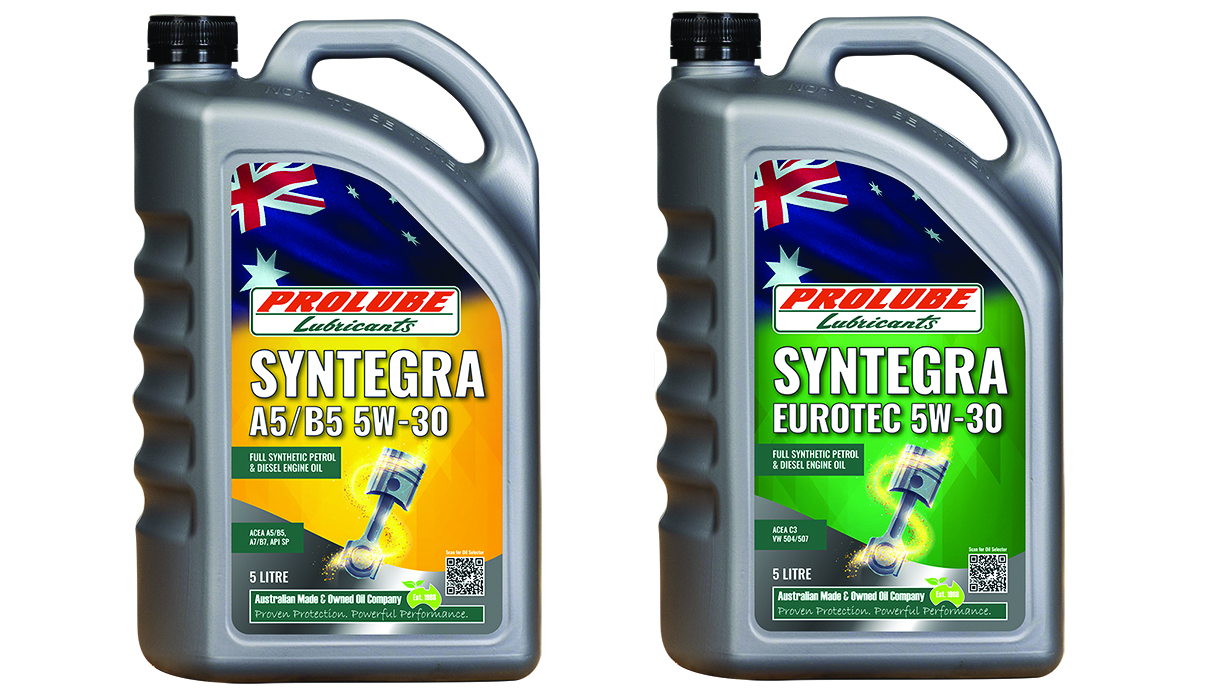
Prolube says its SYNTEGRA full-synthetic engine oil range reflects just how varied modern lubrication requirements have become.
It spans EZIFLOW 0W-20 and 5W-30, C3 5W-30 and 5W-40, A5/B5 5W-30 and EUROTEC 5W-30, providing different viscosity and specification combinations for modern petrol and diesel applications.
But even oils carrying the same 5W-30 viscosity grade can be designed to do very different jobs.
SYNTEGRA A5/B5 5W-30, for example, is an energy-conserving, low-viscosity oil developed specifically for engines requiring the A5/B5 specification, including applications requiring Ford WSS-M2C913-D.
By comparison, SYNTEGRA EUROTEC 5W-30 meets specifications including VW 504 00/507 00, MB 229.51/229.52 and BMW Longlife-04, and is suitable for many diesel engines fitted with DPFs.
“Same 5W-30 on the label, but distinctly different formulations and applications, which is a useful reminder that viscosity is only one part of choosing the right oil,” James said.
Importantly, viscosity also matters beyond the engine.
Prolube’s SYNTEGRA AUTOSYN synthetic automatic transmission fluids include AUTOSYN MV for a broad range of American, European, and Asian vehicles and AUTOSYN LV for transmissions requiring lower-viscosity fluids.
Now, Prolube says its new SYNTEGRA AUTOSYN ULV takes the progression further.
“This full-synthetic, ultra-low-viscosity ATF is formulated for many of the latest 10-speed transmissions, providing fast fluid flow and shear stability to support smooth, responsive shifting, reduced friction losses and improved fuel efficiency,” James said.
“From 0W-20 engine oils to ultra-low-viscosity transmission fluids, one principle remains constant: lower isn’t automatically better, and neither is thicker. The right viscosity is the one the vehicle was engineered to use.
“With Prolube Lubricants, you can benefit from proven protection, and powerful performance.”
Prolube invites you to find the right lubricant by registration or equipment using its online oil selector tools.
For more information or to find your nearest distributor, contact sales@prolube.com.au or 07 3881 1733, or visit www.prolube.com.au