

BREMBO’S INNOVATIVE TWO-PIECE BRAKE DISCS
The brake company brings its OE-developed two-piece brake disc technology to the aftermarket, offering direct replacement components engineered from its original equipment expertise
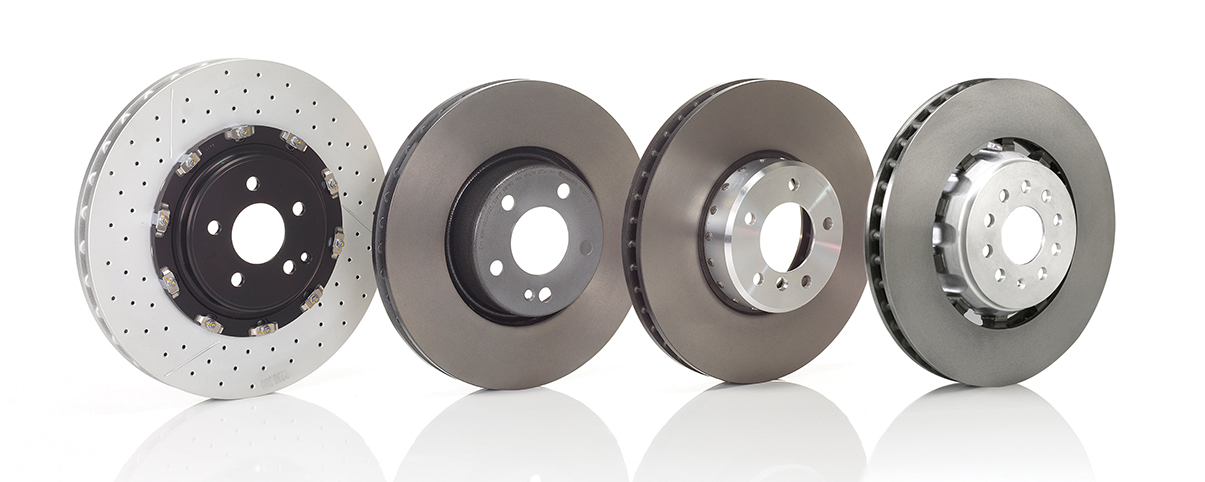
Brembo has long been recognised within the global automotive industry as a major original equipment (OE) manufacturer of braking systems for leading global vehicle brands. The company’s Prime two-piece brake disc technologies – Floating, Composite, Co-cast, and Dual Cast designs – were originally engineered for OE applications. Brembo states that the same engineering principles have been transferred directly into its aftermarket catalogue as OE replacement components.
OE Origins and Aftermarket Availability
Brembo originally developed its Prime two-piece disc architecture for some of the world’s most prestigious vehicle manufacturers. The company highlights that the same manufacturing processes, quality controls, metallurgy and structural design principles used in its OE programs are applied to the aftermarket versions. Because Brembo is the OE manufacturer for many of these braking systems, the aftermarket components are positioned as direct OE replacements.
The company also presents itself as an OE innovator – designing, testing and producing braking systems installed as factory equipment on high-performance and luxury vehicles. Its experience in motorsport, high-temperature brake environments and advanced friction technology has influenced the materials, construction and mechanical interfaces used across the two-piece disc range.
Engineering Features Highlighted
Brembo identifies several engineering features common to its two-piece disc families, describing these as technologies originating from its OE development work.
Special Cast-Iron Alloys: The braking surface is made from high-carbon cast-iron alloys. According to the manufacturer, these alloys are selected for their behaviour under repeated thermal cycling, a condition typical of OE braking systems. Brembo notes that the higher carbon content is intended to support stability at elevated temperatures.
Two-Piece Hat and Rotor Construction: Each disc pairs a cast-iron friction surface with either an aluminium or steel hat. Aluminium hats are used on Floating, Composite and Dual Cast models, while steel hats are used on Co-cast discs. Brembo attributes weight reductions of 15 to 30 per cent to this two-piece architecture when compared with one-piece discs of equivalent size.
Lightened Hat and Mechanical Interface: Brembo states that the hat assemblies are machined to minimise mass without sacrificing rigidity. Depending on the disc type, the surface and hat are connected by pins, bushes, mechanical interference or intercasting. These interfaces are described as allowing the braking surface to undergo controlled radial expansion during temperature increases.
Venting, Grooves and Drilling
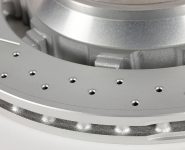
The two-piece disc families incorporate a variety of OE-derived ventilation strategies. These include pillar venting, directional venting, drilled holes and machined grooves. Brembo indicates that these design elements influence airflow through the disc, assist in friction-surface refresh and may help manage water dispersion.
Thermal Expansion Management
Floating and Composite discs use mechanical connections such as bushes or steel pins between the hat and braking surface. According to Brembo, this allows the braking surface to expand independently under thermal load, minimising the stresses that can occur during repeated heating cycles. This principle is described as being carried directly from OE applications into the aftermarket versions.
Range Overview: OE Technology Brought to the Aftermarket
Floating Discs: Originating from Brembo’s performance and racing programs, Floating discs use an aluminium hat connected to a cast-iron surface via bushes. The aftermarket catalogue includes more than 26 references derived from OE fitments.
Composite Discs: Designed mainly for BMW models, Composite discs use an aluminium hat joined to the braking surface via steel pins. Brembo identifies these discs as direct replacements reflecting BMW’s OE specifications.
Co-cast Discs: Used as OE equipment on several Mercedes-Benz models, Co-cast discs feature a steel hat fused to a high-carbon cast-iron surface through an intercasting process. Brembo states that these discs meet recognised international standards.
Dual Cast Discs: Available for high-performance models from Audi, Alfa Romeo, Aston Martin, Maserati and Mercedes-AMG, Dual Cast discs combine a cast-iron surface with an aluminium hat. Brembo positions them as an OE-grade solution now accessible to the aftermarket.
Positioning in the Market
Throughout the Prime range, Brembo emphasises that the materials, construction principles and engineering methodologies used in its aftermarket two-piece discs originate from its OE programs. These discs are positioned as OE-equivalent replacements produced by the same manufacturer responsible for the factory-installed systems.
For more information, visit www.bremboparts.com