
THE AGEING CAR PARC: THE OUT OF SIGHT OPPORTUNITY FOR WORKSHOPS
Australia’s vehicle parc is getting older – by 2030, the share of vehicles aged 16 years and above is projected to reach 35 percent
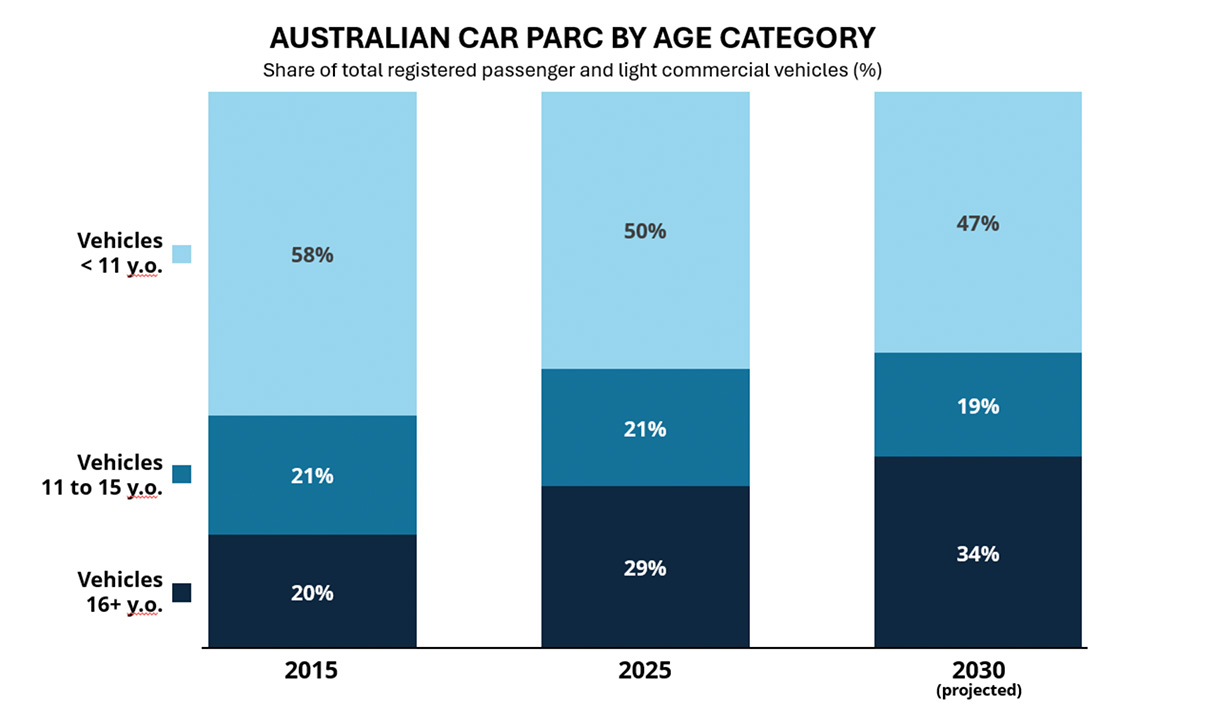
Dominated by petrol-powered workhorses like the Toyota Corolla, Camry, and RAV4; the Mazda3; and models from brands that no longer manufacture locally (or at all, such as the Holden Commodore and Ford Falcon), these aren’t vehicles heading for the scrapyard – they are daily drivers, family cars, and commercial workhorses still clocking up kilometres.
What’s keeping them on the road is straightforward: cost-of-living pressures have made trading up a harder sell, and with vehicle prices and borrowing costs still elevated, that calculus is unlikely to change soon.
Australians are holding on to what they have, and for aftermarket workshops, that means the opportunity isn’t arriving sometime in the future: it is already parked outside.
The shift away from dealerships
For vehicles more than 10 years old, the migration to independent workshops is already well underway, and in many cases is the only option.
For orphan brands like Holden, where the dealer network has dissolved entirely, an authorised service centre is no longer a practical choice.
But Holden is not the only story. Dealer networks for several active brands have contracted significantly over the past decade.
Mitsubishi and Suzuki have reduced their franchise footprints, particularly in regional and suburban markets.
For the owner of a 12-year-old Outlander or a well-worn Swift, the nearest authorised dealer may now be an hour’s drive away.
The vehicles don’t stop needing servicing – the work simply moves down the road, to whichever independent workshop is ready to take it.
Diesel 4WDs: the high-value servicing opportunity
Within the ageing parc, diesel-powered 4WDs and large SUVs stand out for their servicing complexity and per-job value.
Heavy-duty SUVs like the Toyota LandCruiser, LandCruiser Prado, Nissan Patrol, and Mitsubishi Pajero are likely to be sitting in your customer database right now, with many having travelled serious kilometres under demanding conditions.
These vehicles can also carry serious maintenance backlogs. EGR valves, DPFs, turbochargers, and injectors all accumulate issues on high-kilometre diesel platforms, and dealerships are often reluctant to touch them on older vehicles.
That creates opportunities for whichever independent workshop has the diagnostic capability to handle it.
The point here is not that any single job needs to be unusually profitable, it is that these vehicles will generate multiple high-value work orders across their remaining service life, and that this service life is longer than most workshop owners assume.
Know your local parc
The data tells us which vehicles are on the road and where they’re concentrated. For workshop owners, this is actionable intelligence: if your local parc is heavy with ageing Commodores and Falcons, your parts sourcing and technician training should reflect that. If Toyota dominates, and it usually does, then understanding the common service requirements of a 15-year-old Corolla or a 200,000km RAV4 becomes a competitive edge.
The AAAA Car Parc Tool gives members the ability to drill into vehicle demographics at postcode level, identifying exactly which makes, models, fuel types, and age groups are concentrated in their area. The upcoming 2025 data updates make this the right moment to align workshop capabilities with the vehicles actually on local roads.
The workshops that understand their local parc, what’s in it, how old it is, and what it needs, will be the ones ready when the work arrives. The rest will wonder where their customers went.
This column was prepared for AAA Magazine by Fifth Quadrant, the AAAA’s partners in the AAAA Aftermarket Dashboard which is delivered to AAAA members each quarter.
For more information about its services, visit www.fifthquadrant.com.au or contact Ben Selwyn on ben@fifthquadrant.com.au