
CHARGED FOR CHANGE PUTS EV WORKFORCE READINESS IN THE SPOTLIGHT
Australia’s transition to electric vehicles is no longer a future issue – it is a live workforce challenge
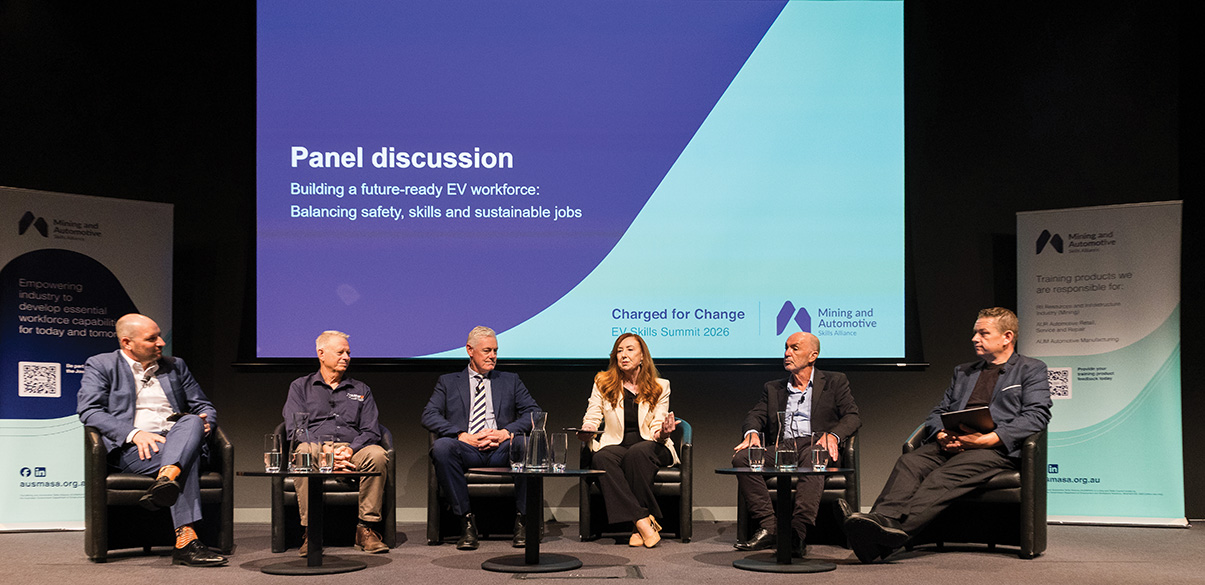
That was the clear message from the ‘Charged for Change: EV Skills Summit,’ convened by the Mining and Automotive Skills Alliance (AUSMASA) in Melbourne on 18 March 2026.
Bringing together more than 130 stakeholders from across Australia, the Summit focused on a critical question: whether Australia’s training system, workforce capability, and safety settings are evolving quickly enough to keep pace with electrification.
Held at a time of rapid change across both the automotive and mining sectors, the event created an important forum for industry, unions, training providers, and policymakers to examine what practical workforce reform now requires.
AUSMASA is the Jobs and Skills Council for Australia’s mining and automotive industries, working with employers, unions, educators and government to identify workforce needs, develop training products, and strengthen the responsiveness of the national training system.
Among the key contributors to the Summit was Australian Automotive Aftermarket Association (AAAA) Director of Government Relations and Advocacy, Lesley Yates, who also chairs AUSMASA’s Automotive Strategic Workforce Advisory Panel (Auto SWAP).
Lesley hosted a panel discussion examining one of the most pressing issues facing the sector: EV workforce readiness.
The purpose of the session was practical and forward-looking – not simply to acknowledge the scale of the EV transition, but to ask what kind of workforce system Australia is building, where the gaps are emerging, and what needs to change if the system is to be safe, scalable, and workable for the real industry.
Lesley led a wide-ranging discussion with Richard Delplace from the Federal Chamber of Automotive Industries (FCAI), Paul Baxter from the Australian Manufacturing Workers’ Union (AMWU), Brian Savage from the Australian Automotive Dealer Association (AADA), Frank Gili from the Construction and Mining Equipment Industry Group (CMEIG), and Shane Randall from CIT.
A major theme to emerge from the session was national harmonisation.
Panellists explored the risks of a fragmented, state-by-state approach to EV skills, safety and licensing, and the strong preference for a nationally coherent framework.
That concern is increasingly shared across industry – a patchwork of state-based licensing regimes would create complexity, duplication and confusion for workers, employers and training providers, while doing little to address the real issue: building practical, nationally recognised capability.
That message aligns with the position AAAA has advocated strongly and consistently: Australia should not respond to electrification with disconnected state licensing schemes.
According to AAAA, the better path is a nationally consistent approach that supports safety, industry mobility and workforce development without creating unnecessary barriers to entry or compliance burdens that vary from one jurisdiction to another.
The panel also highlighted the importance of ensuring EV training is not framed purely as a compliance obligation. Workers are being asked to take on greater technical complexity, more responsibility and higher-risk tasks, and that means the system must support genuine career progression and recognition of higher-level capability – not simply impose extra requirements without a clearer skills pathway in return.
What gave the Summit its strength was the practical tone of the discussion. Rather than treating electrification as an abstract policy trend, the event focused on the real conditions needed to make the transition workable: fit-for-purpose training, current equipment, national consistency, recognition of higher-level skills, and pathways that reflect how work is actually carried out across workshops, dealerships, training organisations and adjacent sectors.
The Charged for Change Summit made clear that Australia has both the expertise and the willingness to work through these issues collaboratively.
It also reinforced that the next stage of reform must be grounded in practicality. Industry wants a workforce model that is safe, scalable and genuinely fit for purpose – one that gives businesses confidence, gives workers meaningful career pathways, and gives the community confidence that EVs can be serviced and repaired by a capable and properly supported workforce.
“For the automotive sector, the direction of travel is clear. Collaboration is growing, the conversation is maturing, and the opportunity to build a stronger national system is real,” Lesley said.
“But that progress will depend on resisting fragmented state responses and focusing instead on harmonised, nationally coherent solutions that support capability rather than bureaucracy.
“In that respect, the Summit was more than just a discussion about EV skills. It was a reminder that workforce reform works best when it is shaped by the people who understand the job.”
To learn more about the EV Summit, visit www.ausmasa.org.au